Sunday, November 20, 2016

TOW #10 - from Words That Work by Frank Luntz

Dr. Frank Luntz is a political consultant who studies polls and focuses groups in order to craft arguments. In this excerpt from his book Words That Work, Luntz originally addresses the spouses of Republican men and women of Congress. In 2007, with the media becoming more and more powerful and the presidential election coming in the next year, Luntz informs the congressional spouses that proper word choice is pivotal.  In this excerpt, Luntz presents real-word examples in addition to using careful diction to emphasize that sometimes leaving out the right words makes all the difference.
In order to support his claim that “effective communication requires that you stop saying words and phrases that undermine your ability to educate the American people,” Luntz gives a list of what to “never say” versus what one should “instead say” followed by an example that appeals to logos.  After one of his lists he writes, “Similarly, ‘capitalism’ reminds people of harsh economic competition that yields losers as well as winners, while ‘the free market economy’ provides opportunity to all and allows everyone to succeed.” He appeals to logos by simply providing what the American people think. He also appeals to pathos with his use of the words “harsh” and “losers”. This lets the spouses realize disdain that the wrong word can cause, causing them to understand how their words can affect an audience. Different connotations of words that mean the same thing can paint a different picture in an audience’s mind. After further establishing his ethos by mentioning his involvement in a “language creation effort involving environmental issues”, he goes on to give another example of how the wrong word can create the wrong picture. “‘Drilling for oil’ causes people to paint a picture in their minds of an old fashioned rig… ‘Exploring for energy’ conjures a picture of twenty-first technology…”. Placing the words “drilling” and “exploring” and “oil”and “energy” right next to each other gives the congressional spouses the opportunity to analyze the differences in the effects of the phrases that mean essentially the same thing. Also, Lentz’s juxtaposition of the terms “old” and “twenty-first century” in his analysis provides the spouses with the mindset of their own audience, the American people. With his specific examples and careful word choice, Lentz effectively conveys the right words have the right meaning and the wrong words don’t.

Wednesday, November 16, 2016

IRB Intro #2

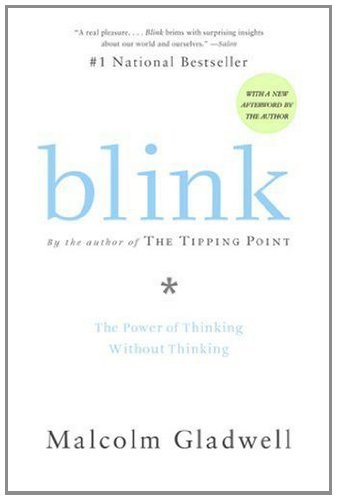
blink by Malcolm Gladwell is the opportunity to see and learn about our subconscious, when we think without thinking. Gladwell presents his research into how the brain works in our everyday lives. His other works include Tipping Point and Outliers in addition to his regular articles for The New Yorker. For this marking period, Eamon and I decided to trade IRB books from last marking period. I trust his judgement and hope that we’ll be able to have good discussion about both of our books.

Sunday, November 6, 2016

TOW #8 - Between the World and Me

Ta-Nehisi Coates writes Between the World and Me as a letter to his son, in light of the recent news that no charges would be brought up against the police officer who killed Michael Brown in Ferguson, Missouri. His book is for all Americans, so they can see what it’s like to be black in America, specifically through Coates’s eyes. He shares personal stories, recounting on what he has learned throughout his life. His title Between the World and Me indicates that his message is a personal one, and is aimed towards everyone. When he mentions his childhood in Baltimore he writes, “Not being violent enough could cost me my body. Being too violent could cost me my body.” Coates had to fend for himself in his hometown while also keeping himself out of trouble. He depicts the harsh reality and helps the reader understand as to how merely trying to live can feel unfair, especially for a child. With accounts from his childhood, Coates also shares realizations that he has come to as an adult. “Black people love their children with a kind of obsession,” he writes. “You are all we have, and you come to us endangered. I think we would like to kill you ourselves before seeing you killed by the streets that America made.” Coates gives his son and America the raw feelings a parent has when they hear of the horror stories happening around the country. No parent wants their child to prematurely lose their life. His statement allows Americans to understand the fear that is put into Black parents’ hearts when their child wants to go to the movies or their school football game. It can happen anywhere and to anyone. If the audience accepts Coates’s invitation to try on his shoes they’ll be able to have a better idea of what it’s like to be black in America.

Wednesday, November 2, 2016

TOW #7 - Nick Anderson Cartoon

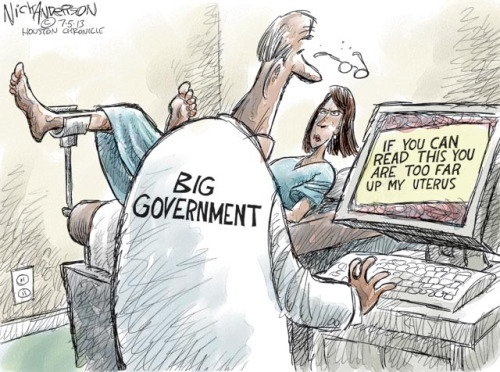
tumblr_mpdq7sFXDn1s0xsaoo1_500.jpg
Nick Anderson is a liberal cartoonist who focuses his drawings mainly on political and social issues within the U.S. The question as to whether abortion is moral or immoral is widely debated around the country. With that also comes the question as to when abortion should be illegal. In 2013, when this cartoon was made, most states had their own laws stating when abortion was illegal. The timeline spanned from after 12 weeks in some states to after 28 weeks in others; nine states had no laws restricting abortion. Also, with the U.S.’s federalist government, the Supreme Court can make final decisions and throw out state laws. In light of the controversy around abortion, Nick Anderson uses the woman’s facial expression and the phrases in the picture to say that a woman should have the final say, and not the federal government, when it comes to her having an abortion.

In the picture, a woman is in a clinic and the doctor is evaluating her body by looking at screen. The audience assumes that the doctor, a man with the words “Big Government” on his back, has some sort of apparatus hooked up to the woman in order to show information. Analyzing the picture all together allows for Americans to see Anderson’s purpose. The text “If you are reading this you are too far up my uterus” in addition to the woman’s facial expression, lets the audience understand that the woman is unhappy with the “big government’s” interference in her decision because she should have control over her body, not an outside party. Also considering that the doctor is a man and not a woman, Anderson presents the idea that a man does not understand what it takes from a woman to birth a child. Since he doesn’t know or understand, he should not be making decisions for her. Most government officials making decisions on abortion laws are men, so Anderson appeals to logos because it seems illogical for a man outside of the situation to make decisions for a woman and her body. She should have the right to make the ultimate decision concerning her body.

Sunday, October 23, 2016

TOW #6 - Maryland and the Marriott

Jonathan O’Connell is a reporter for The Washington Post. For the past five years, he has been writing about land use and the connection between government and community, as well urban and economic development. In his writing, O’Connell shows the influence that corporations have over U.S. states today. Specifically, Maryland was recently under pressure to keep the Fortune 500 Company Marriott in their state lines because there was question as to whether Marriott would leave or not. Currently, Maryland cannot afford to lose Marriott because the corporation helps to fuel Maryland’s economy by providing thousands of jobs. Also, Marriott’s big name looks good and Maryland officials want to keep it in the state. O’Connell writes The trap that causes states to give millions to corporations like Marriott primarily for the people of Maryland, who would want to know how their economy can be affected. O’Connell uses an anecdote and state government officials’ statements to inform Maryland’s residents of the influence that Marriott has over the state.
O’Connell accomplishes his purpose well. To start the article, he uses an anecdote and ties it directly into the context and topic. He writes,
In 1999, then-Maryland Gov. Parris Glendening was under pressure from J.W. “Bill” Marriott Jr. for millions of dollars to keep the hotel giant Marriott International in the state. Wrestling with how to respond, Glendening stepped into the Annapolis office of fellow Democrat Maryland Senate President Thomas V. Mike Miller Jr., who offered some advice. “He said, ‘Listen, you don’t want to be the governor who lost Marriott to Virginia,’ " Glendening recalled recently.

O’Connell then writes that “17 years later, nearly the exact same thing has happened.” Having the history of the interactions between Marriott and the State gives Maryland residents a better understanding of what is happening and what the likely outcome is. The anecdote also gives a clear understanding of how corporations influence the state and gives insight into the way state government officials think when making decisions. Simply, Marriott’s stature gives it the power to influence the state. With the anecdote, O’Connell uses statements made by state government officials to show Marriott’s influence. When talking about Marriott’s possible departure, David Ianucci, who helped decide the deal with Marriott says, “It was something we had to do… There would have been a fallout of the state’s business climate, reputation had they left.” O’Connell’s use of statements gives a clear example how Marriott effects the state of Maryland and why it cannot leave. Marriott’s departure would greatly impact Maryland in a most likely negative way, and state officials did not want to be responsible for it.

Sunday, October 16, 2016

TOW #5 - Double Solitude by Donald Hall

Donald Hall is a critically acclaimed poet, writer and editor. His writing often exemplifies his love for nature and peace. In Double Solitude, Hall gives the reader his perspective on solitude and how his love of it has affected his life. In Double Solitude, Hall is 87 and reflecting on his life and his marriages. This essay was written for people who choose to be alone; to let them know how the solitude that they love will take a toll on them in the long run. Hall effectively conveys this message with a couple of rhetorical strategies. Using repetition and heart-warming irony, Donald Hall lets solitude lovers know how he felt after a life of solitude, in order to prevent them from feeling the same way.
Throughout the essay, Hall uses repetition to draw emphasis to his love of solitude. In the start of the essay, Hall writes, “I spend my days alone… and lie back in the enormous comfort of solitude.” Later after he details his marriage and divorce with his first wife he writes, “For five years I was alone again, but without the comfort of solitude.” Hall’s reiteration of the “comfort of solitude” gives the audience an understanding of how Hall views solitude. His repetition lets his fellow solitude lovers relate to him while it allows other readers to have sympathy for him. After his use of repetition throughout his essay, Hall reveals his purpose with irony. After he tells the reader of the “double solitude” he shared with his second wife Jane, before she died, Hall writes, “Last January I grieved that she would not be beside me as I died.” Hall puts heavy emphasis on the comfort of solitude and then writes that he does not find that comfort in the end, and that he wishes he was with his wife. The ironic shift in Hall’s perspective unveils his purpose and shows his deep regret.

Sunday, October 9, 2016

TOW #4 - IRB Between the World and Me by Ta-Nehisi Coates

Ta-Nehisi Coates is an African-American,  award winning writer and educator. He grew up in West Baltimore and studied at Howard University. Coates primarily addresses cultural, political, and social issues in the U.S. In the first half of Between the World and Me, Coates begins his letter to his son and attempts to delve into the unanswerable question: “How do I live free in this black body?” (12). The book is a letter to his son David, who is becoming aware of the tragedies many young black boys like him  face. Coates writes in order to help his son start his own journey of investigation of the answer to his question and also to enlighten his son and others of the history of African Americans. To do this, Coates tells his own story. While Coates primarily writes to his son, he also writes to anyone who can relate, and those who seek more information in their own investigation for answers. In order to enlighten his son on the plight of African American people, Coates uses emotional anaphora and thought provoking metaphors.

When detailing his memories of watching videos in grammar school of the Civil Rights Movement, he writes, “The black people in these films seemed to love the worst things in life—love the dogs that [rip] their children apart… love the men who raped them… love the children who spat on them” (32). Coates’s repeated us the word “love” emphasizes the number of troubling things in the lives of African Americans. It puts emphasis on how ingenuine the video seemed. Also, the irony between the word “love” and the negative event after it creates a depressed mood in the reader. The combination of the emphasis and the mood created gives Coates’s son a feeling similar to what Coates felt in grammar school. The combination allowed his son to feel the history rather than just learn it. In order to help create a vivid picture of the past, when describing his experiences in West Baltimore, Coates writes, “North and Pulaski was not an intersection but a hurricane, leaving only splinters and shards in its wake” (22). His tone and use of metaphor gives his son a more genuine account of what life was like for him. Coates does not want to sugar coat his stories because they weren’t sugarcoated when he was experiencing them. The raw realness of Coates’s account even further allows his son and others to understand the history.