Sunday, October 23, 2016

TOW #6 - Maryland and the Marriott

Jonathan O’Connell is a reporter for The Washington Post. For the past five years, he has been writing about land use and the connection between government and community, as well urban and economic development. In his writing, O’Connell shows the influence that corporations have over U.S. states today. Specifically, Maryland was recently under pressure to keep the Fortune 500 Company Marriott in their state lines because there was question as to whether Marriott would leave or not. Currently, Maryland cannot afford to lose Marriott because the corporation helps to fuel Maryland’s economy by providing thousands of jobs. Also, Marriott’s big name looks good and Maryland officials want to keep it in the state. O’Connell writes The trap that causes states to give millions to corporations like Marriott primarily for the people of Maryland, who would want to know how their economy can be affected. O’Connell uses an anecdote and state government officials’ statements to inform Maryland’s residents of the influence that Marriott has over the state.
O’Connell accomplishes his purpose well. To start the article, he uses an anecdote and ties it directly into the context and topic. He writes,
In 1999, then-Maryland Gov. Parris Glendening was under pressure from J.W. “Bill” Marriott Jr. for millions of dollars to keep the hotel giant Marriott International in the state. Wrestling with how to respond, Glendening stepped into the Annapolis office of fellow Democrat Maryland Senate President Thomas V. Mike Miller Jr., who offered some advice. “He said, ‘Listen, you don’t want to be the governor who lost Marriott to Virginia,’ " Glendening recalled recently.

O’Connell then writes that “17 years later, nearly the exact same thing has happened.” Having the history of the interactions between Marriott and the State gives Maryland residents a better understanding of what is happening and what the likely outcome is. The anecdote also gives a clear understanding of how corporations influence the state and gives insight into the way state government officials think when making decisions. Simply, Marriott’s stature gives it the power to influence the state. With the anecdote, O’Connell uses statements made by state government officials to show Marriott’s influence. When talking about Marriott’s possible departure, David Ianucci, who helped decide the deal with Marriott says, “It was something we had to do… There would have been a fallout of the state’s business climate, reputation had they left.” O’Connell’s use of statements gives a clear example how Marriott effects the state of Maryland and why it cannot leave. Marriott’s departure would greatly impact Maryland in a most likely negative way, and state officials did not want to be responsible for it.

Sunday, October 16, 2016

TOW #5 - Double Solitude by Donald Hall

Donald Hall is a critically acclaimed poet, writer and editor. His writing often exemplifies his love for nature and peace. In Double Solitude, Hall gives the reader his perspective on solitude and how his love of it has affected his life. In Double Solitude, Hall is 87 and reflecting on his life and his marriages. This essay was written for people who choose to be alone; to let them know how the solitude that they love will take a toll on them in the long run. Hall effectively conveys this message with a couple of rhetorical strategies. Using repetition and heart-warming irony, Donald Hall lets solitude lovers know how he felt after a life of solitude, in order to prevent them from feeling the same way.
Throughout the essay, Hall uses repetition to draw emphasis to his love of solitude. In the start of the essay, Hall writes, “I spend my days alone… and lie back in the enormous comfort of solitude.” Later after he details his marriage and divorce with his first wife he writes, “For five years I was alone again, but without the comfort of solitude.” Hall’s reiteration of the “comfort of solitude” gives the audience an understanding of how Hall views solitude. His repetition lets his fellow solitude lovers relate to him while it allows other readers to have sympathy for him. After his use of repetition throughout his essay, Hall reveals his purpose with irony. After he tells the reader of the “double solitude” he shared with his second wife Jane, before she died, Hall writes, “Last January I grieved that she would not be beside me as I died.” Hall puts heavy emphasis on the comfort of solitude and then writes that he does not find that comfort in the end, and that he wishes he was with his wife. The ironic shift in Hall’s perspective unveils his purpose and shows his deep regret.

Sunday, October 9, 2016

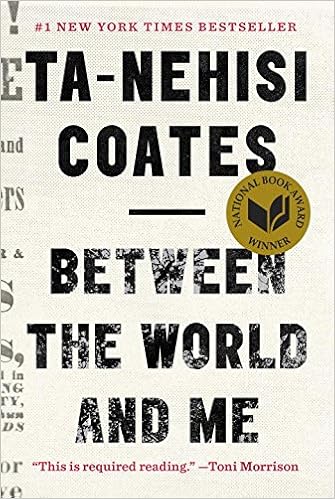
TOW #4 - IRB Between the World and Me by Ta-Nehisi Coates

Ta-Nehisi Coates is an African-American,  award winning writer and educator. He grew up in West Baltimore and studied at Howard University. Coates primarily addresses cultural, political, and social issues in the U.S. In the first half of Between the World and Me, Coates begins his letter to his son and attempts to delve into the unanswerable question: “How do I live free in this black body?” (12). The book is a letter to his son David, who is becoming aware of the tragedies many young black boys like him  face. Coates writes in order to help his son start his own journey of investigation of the answer to his question and also to enlighten his son and others of the history of African Americans. To do this, Coates tells his own story. While Coates primarily writes to his son, he also writes to anyone who can relate, and those who seek more information in their own investigation for answers. In order to enlighten his son on the plight of African American people, Coates uses emotional anaphora and thought provoking metaphors.

When detailing his memories of watching videos in grammar school of the Civil Rights Movement, he writes, “The black people in these films seemed to love the worst things in life—love the dogs that [rip] their children apart… love the men who raped them… love the children who spat on them” (32). Coates’s repeated us the word “love” emphasizes the number of troubling things in the lives of African Americans. It puts emphasis on how ingenuine the video seemed. Also, the irony between the word “love” and the negative event after it creates a depressed mood in the reader. The combination of the emphasis and the mood created gives Coates’s son a feeling similar to what Coates felt in grammar school. The combination allowed his son to feel the history rather than just learn it. In order to help create a vivid picture of the past, when describing his experiences in West Baltimore, Coates writes, “North and Pulaski was not an intersection but a hurricane, leaving only splinters and shards in its wake” (22). His tone and use of metaphor gives his son a more genuine account of what life was like for him. Coates does not want to sugar coat his stories because they weren’t sugarcoated when he was experiencing them. The raw realness of Coates’s account even further allows his son and others to understand the history.

Sunday, September 25, 2016

TOW #3 - A Cartoon Drawn by Dr. Seuss


Before and during World War II, Theodor Seuss Geisel, or Dr. Seuss, created an array of racially charged political cartoons. At the time, there was widespread suspicion that Japanese citizens were disloyal to the U.S. and were spies for Japan. Because of this, many, including Seuss, held a prejudice against and a fear of Japanese citizens.  Though he was not as popular at the time as he is now, he had been creating and publishing cartoons since he attended Dartmouth College in 1925. Before his children’s books, Seuss composed cartoons like this mainly for adult audiences, specifically Americans. In this cartoon, Dr. Seuss aims to depict all Japanese citizens as dangerous and traitorous. Seuss shows a long line of Japanese citizens along the states of the west coast (where the Japanese population was the highest). His depiction of them standing in line waiting for explosives, stereotypes the Japanese citizens as dangerous and a threat to the safety and security of all Americans. With this depiction, Seuss appeals to pathos by playing on the fear of the Americans. In addition to the explosives, at the top of the booth, Seuss writes, “Honorable 5th Column,” which is defined as an organization that aims to undermine the larger group that it is in, often for the larger group’s enemy. This, including the words “Waiting for the Signal From Home…” along the top appeals to logos because it was not uncommon for first generation of Japanese citizens to have loyalties to Japan. These loyalties made it plausible that there were Japanese spies. Also, the man on top of the booth seemingly looking towards Japan, reiterates the idea that the Japanese citizens were loyal to Japan and awaiting its orders. For the time period, Dr. Seuss was effectively spread the idea that Japanese citizens were dangerous spies. His appeals to pathos and logos were very effective and made it very plausible that what he was portraying was true. However, Seuss failed to recognize all of the facts surrounding the subject. There were many reports and investigations that conveyed how Japanese citizens were not threats to American security and were loyal to the U.S. While, Dr. Seuss did accomplish his purpose during WWII, he fails to now.


Sunday, September 18, 2016

TOW #2 - The Lives of a Cell by Lewis Thomas


Lewis Thomas was a physician and essayist who studied at Princeton University and Harvard Medical School. In The Lives of Cell he compares the earth to a single biological cell and describes humans as being part of that cell. In light of the belief that Man is trying to detach himself from a fragile Earth, Thomas wants modern-day humans, that understand the basic components of biological cells, to understand that they are not overseers of the Earth, but rather smaller parts of a complex system with the Earth. Thompson achieves his purpose through the use of a metaphor, an allegory, and personification. To contradict the common belief that Man has power over the Earth, Thomas writes, “... [the earth] is the toughest membrane … we are the delicate part, transient and vulnerable as cilia.” Comparing people to cilia on the outside of a cell membrane gives the reader an image of how insignificant and powerless people are in relation to the Earth. Also, this metaphor exhibits the mutual dependence of people and the Earth for cilia cannot function independently of the cell, and on the cell, they serve a specific purpose for it. Additionally, Thomas shares the story of how the modern-day mitochondria became a part of the eukaryotic cell. He described the mitochondrion, the organelles that makes energy, as “separate creatures” that have “maintained themselves” and possess their “own special genome.” This allegory presents the idea that people are not in total control of themselves and that there are smaller forces that control us; which magnifies our insignificance as individuals. After Thomas describes the mitochondrion, he questions what else governs his body. He wonders that “perhaps it is they who walk through the local park in the early morning, sensing my senses, listening to my music, thinking my thoughts.” The personification of the components of our cells emphasizes the idea that people are not in control of themselves and that their is another force carrying out actions for us.

Sunday, September 11, 2016

TOW #1 - The Front Line Against Birthright Citizenship

U.S. born children of undocumented Mexican immigrants are having their citizenship tested in Texas. Thousands of natural-born children are being deprived of their full rights because of their immigrant parents. Parents cannot receive birth certificates for their children born in the U.S. because they do not possess an acceptable form of I.D. The only accessible form of I.D. that many immigrants have, the matrícula consular, was no longer accepted after 2008 because it wasn’t secure enough. Families filed a lawsuit against the state of Texas in order to get a form of identification that is both acceptable and accessible. The author of this article, Jonathan Blitzer, is an editor for The New Yorker that often writes about American politics. He studied English and philosophy at Columbia University. Blitzer writes for the American public in effort to bring light to Texas’s alleged discrimination against Mexican immigrants. Blitzer achieves his purpose well with his tone and irony. Blitzer’s use of phrases like  “stripped away the rights” and “another mother had to fight” lets the reader see the situation as unconstitutional and unfair to the immigrants. Additionally, after he questions Texas’s intentions for fighting the lawsuit, Blitzer includes a quote from the Dallas County Commissioner, who says, “I am aware of the concerns about the reliability of the consular identification document. However, I am hard pressed to imagine how its use in this context poses any threat of identity theft, fraud, or other abuse.” The irony of the Dallas County Commissioner saying this makes the reader question Texas’s motives. Finally, the reader makes the connection when Blitzer includes a thought from a congressman who believes that “the state’s response to the lawsuit coincides with a broader effort to create a federal court case around birthright citizenship.” Since birthright citizenship, in Texas, primarily affects Mexican immigrants, Blitzer conveys to the reader that Texas’s actions are discriminatory.

The Front Line Against Birthright Citizenship - The New Yorker

Thursday, September 8, 2016

IRB Intro #1

Ta-Nehisi Coates wrote award-winning Between the World and Me as a letter to his son about the reality of being a black citizen in America.  With influence from James Baldwin, Coates uses history as well as personal experience to convey his message. In addition to writing Between the World and Me, Coates often writes about cultural, political, and social issues within America. I chose this book because it was recommended to me by former teachers and friends, and because it will enhance my knowledge. I am eager to learn Coates’s perspective and outlook on the reality of being a black citizen in America.